

2025-01-22
A Georgia Tech-led review paper recently published in Nature Reviews Physics is exploring the ways machine learning is revolutionizing the field of climate physics — and the role human scientists might play.
2024-12-13
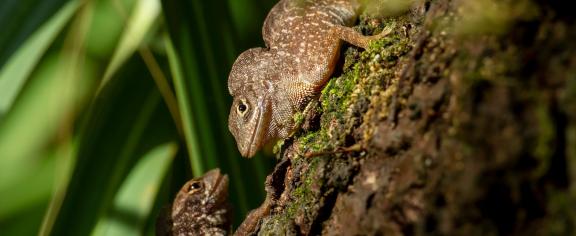
The Georgia Tech-led study captures two lizard species adapting in response to competition. The study provides some of the clearest evidence to date of evolution in action.

2024-12-11
Led by School of Earth and Atmospheric Sciences Professor Greg Huey, the NSF RAPID grant is for analyzing air chemistry data collected during a three-week span when a chemical plume impacted the Atlanta area.
2024-04-05
Georgia Tech’s Climate Action Plan outlines mitigation and adaptation strategies for reaching net-zero emissions on campus by 2050 and contributing to global solutions through education and research.
2023-09-06
Their novel approach showed how mammal traits evolved with changing environments over time and revealed factors that contributed to biodiversity loss.
2023-06-13
The interdisciplinary Environmental Science (ENVS) degree program, developed by faculty in the Schools of Earth and Atmospheric Sciences and Biological Sciences, is now enrolling students interested in a wide variety of environment-related careers.
2023-06-12
On July 1, SLS will launch the Center for Sustainable Communities Research and Education.
2023-05-30
Researchers at the Georgia Institute of Technology and Yale University are proposing a novel pathway through which coastal ecosystem restoration can permanently capture carbon dioxide from the atmosphere.