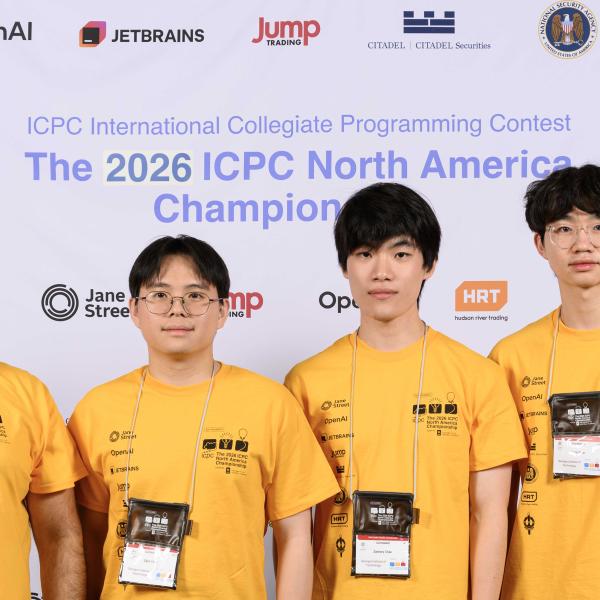
Georgia Tech’s competitive programming team placed seventh at the International Collegiate Programming Contest (ICPC) North America Championship (NAC), earning a bronze medal and further cementing its standing among the continent’s elite collegiate teams.
The NAC is the highest level of regional competition in the ICPC.
Preparation, Chemistry Drive Performance
For the team, the achievement was the product of months of deliberate preparation and a carefully balanced roster.
“We’ve been practicing consistently since September,” said Kevin Shan, a third-year computer science (CS) student and three-year team member. “As a result, we’ve developed pretty strong team chemistry as well as a good understanding of what each person’s strengths are.”
That chemistry proved critical in a contest format that demands technical mastery and coordination under pressure. ICPC competitions require teams to collaboratively solve complex algorithmic problems within a fixed time limit, often forcing quick decisions about strategy, debugging, and division of labor.
A Team Built on Experience and Talent
The team reflects a blend of experience across multiple levels of competitive programming. Shan earned his second NAC medal this year, while first-year CS student Zachary Chao entered with adistinguished background, including a bronze medal at the International Olympiad in Informatics (IOI) representing Taiwan. Zejia Chen, a PhD student, added further depth as a former ICPC World Finals competitor.
Despite differences in format, Chao said the transition from individual to team competition was natural.
“Although IOI and ICPC have very different contest formats, the skills required to excel in both competitions are very similar,” he said. “I had to adapt to the team environment, but in terms of problem solving, my experience definitely translated.”
He also emphasized that success in competitive programming is less about seniority and more about skill and practice.
“I feel like grade level isn’t too relevant to ICPC,” he said. “As long as a contestant is able to compete at a certain level, it doesn’t really matter what grade they are.”
Moments That Defined the Competition
For Shan, competing at multiple levels over three years has sharpened his understanding of how each stage differs. “The contests at different levels—regionals, NAC, and World Finals—all have unique characteristics,” he said. “It’s important not only to practice on different sets for these contests but also to approach them differently.”
The emotional turning point came at the very end of the competition. After struggling to debug the final solution, the team members were unsure of how they had performed. “We were all pretty bummed,” Shan said. “So the best part was definitely finding out at the award ceremony that we were awarded a medal.”
Beyond the results, Georgia Tech’s reputation was evident throughout the competition. According to School of Computing Instruction faculty member and ICPC advisor Abrahim Ladha, competitors from other universities recognized the team.
“Walking around with them, they were treated like celebrities. Competitors from other schools knew of them, the way people talk about Haynes King or something,” Ladha said.
“Getting a bronze at NAC is a huge deal, and they all will have jobs lined up because of this.”
Looking Ahead
Chen, who has competed internationally, noted that the NAC stands out not just for its difficulty but also for the broader experience it offers. Compared to the competitions he attended during his undergraduate years, he described NAC as “much richer and more engaging,” with opportunities to connect with peers, attend talks, and explore career pathways alongside the contest.
At the same time, the team remains focused on continued growth. “Winning a bronze medal gives us encouragement,” Chen said, noting that the experience will help guide their preparation for future competitions.